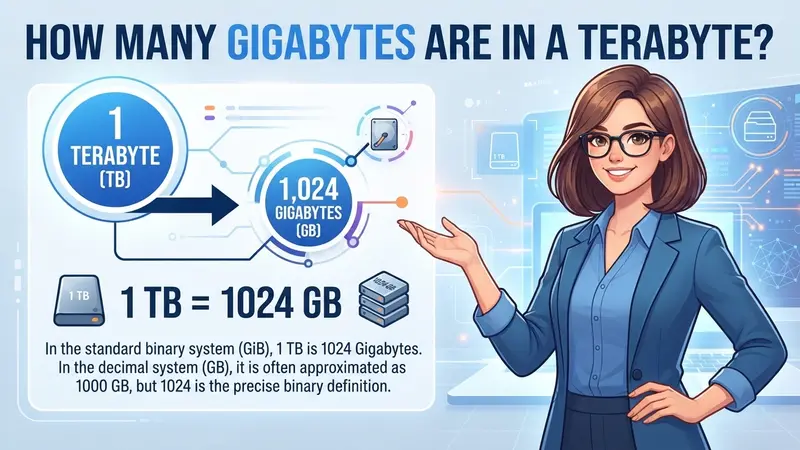
Understanding digital storage units is important when choosing a hard drive, SSD, memory card, cloud storage plan, or computer. One common question people ask is: how many gigabytes are in a terabyte? The answer is usually 1,000 gigabytes (GB) in 1 terabyte (TB) when using the decimal storage system. However, computers can also use a binary measurement system, where 1 tebibyte (TiB) equals 1,024 gibibytes (GiB).
This difference can make storage capacity appear smaller than expected. For example, a drive advertised as 1 TB may not display exactly 1,000 GB in an operating system.
In this guide, we will explain the relationship between terabytes and gigabytes, show simple conversions, discuss decimal and binary measurements, and explain how much data you can realistically store in a terabyte.
What Is a Gigabyte?
A gigabyte (GB) is a commonly used unit for measuring digital data. It is larger than a megabyte (MB) and smaller than a terabyte (TB).
In the decimal system:
- 1 gigabyte = 1,000 megabytes
- 1 terabyte = 1,000 gigabytes
Gigabytes commonly describe the storage capacity of smartphones, computers, USB drives, memory cards, and smaller cloud-storage plans.
For example, a smartphone might have 128 GB or 256 GB of storage, while a laptop could have a 512 GB SSD.
What Is a Terabyte?
A terabyte (TB) is a larger unit of digital storage. People commonly use it for hard drives, SSDs, external storage devices, servers, and cloud-storage services.
Using the decimal system:
1 TB = 1,000 GB
This means a 2 TB storage drive provides approximately 2,000 GB of advertised capacity, while a 4 TB drive provides approximately 4,000 GB.
How Many Gigabytes Are in a Terabyte?
The simple answer is:
1 terabyte = 1,000 gigabytes
This is the decimal standard commonly used by storage manufacturers.
| Storage Unit | Decimal Equivalent |
|---|---|
| 1 Megabyte (MB) | 1,000 KB |
| 1 Gigabyte (GB) | 1,000 MB |
| 1 Terabyte (TB) | 1,000 GB |
| 1 Petabyte (PB) | 1,000 TB |
So, if you have a 1 TB hard drive, its advertised capacity is 1,000 GB.
Why Do Some Sources Say 1 TB Equals 1,024 GB?
You may have seen the statement that 1 TB equals 1,024 GB. This comes from the binary measurement system traditionally used in computing.
Strictly speaking, the binary units have different names:
- 1 tebibyte (TiB) = 1,024 gibibytes (GiB)
- 1 gibibyte (GiB) = 1,024 mebibytes (MiB)
The confusion happens because older computer terminology often used GB and TB when referring to binary values. Modern storage manufacturers generally use decimal measurements when advertising drive capacity.
1 TB vs. 1,024 GB Explained
The difference can be summarized simply:
Decimal system:
1 TB = 1,000 GB
Binary system:
1 TiB = 1,024 GiB
Therefore, if someone asks how many gigabytes are in a terabyte for normal storage-product specifications, 1,000 GB is the straightforward answer.
How Much Data Can 1 TB Store?
A terabyte provides substantial storage. The exact amount of content depends on file size and format, but 1 TB can hold many types of digital files.
For example, it could store:
- Thousands of photos
- Hundreds of hours of compressed video
- Large collections of documents
- Numerous software applications
- Music libraries
- Computer backups
- Game installations
Modern high-resolution videos and games can consume storage quickly, so the actual number of files that fit on a 1 TB drive varies considerably.
Common Terabyte Conversions
Here are some useful examples:
| Terabytes | Gigabytes |
|---|---|
| 0.5 TB | 500 GB |
| 1 TB | 1,000 GB |
| 2 TB | 2,000 GB |
| 4 TB | 4,000 GB |
| 5 TB | 5,000 GB |
| 10 TB | 10,000 GB |
This makes it easy to estimate the capacity of larger storage devices.
Why Storage Capacity May Look Different on Your Computer
When you buy a storage device, the capacity shown on its packaging may not exactly match what your computer displays.
One reason is the difference between decimal and binary measurements. Operating systems also use some storage space for formatting, file-system structures, system data, and other technical purposes.
For example, a drive marketed as 1 TB is based on 1,000,000,000,000 bytes. The usable space a computer displays can therefore appear lower, depending on how the operating system reports capacity.
This doesn’t necessarily mean the storage manufacturer provided less capacity.
Terabyte vs. Gigabyte: Which Is Bigger?
A terabyte is larger than a gigabyte.
The relationship is:
1 TB = 1,000 GB
Therefore:
- 1 GB is a smaller storage unit.
- 1 TB is 1,000 times larger than 1 GB in the decimal system.
- Larger storage devices are often measured in terabytes.
For example, a 4 TB external hard drive has four times the advertised capacity of a 1 TB drive.
Frequently Asked Questions
Is 1 TB equal to 1,000 GB?
Yes. In the decimal storage system commonly used by storage manufacturers, 1 TB equals 1,000 GB.
Is 1 TB equal to 1,024 GB?
Not exactly under modern terminology. 1 TiB equals 1,024 GiB in the binary system. TB and GB usually refer to decimal measurements.
Is 1 TB enough storage?
For many users, 1 TB can provide plenty of space for documents, photos, music, applications, and general personal files. Users who work with large video files, extensive game libraries, or professional media projects may need several terabytes.
How many GB are in 2 TB?
Using the decimal system, 2 TB equals 2,000 GB.
How many GB are in 5 TB?
Using the decimal system, 5 TB equals 5,000 GB. Learn More about Technology tips.
Conclusion
So, how many gigabytes are in a terabyte? The standard answer is 1,000 gigabytes in 1 terabyte when using decimal measurements. Storage manufacturers commonly use this system to describe hard drives, SSDs, memory devices, and cloud-storage capacities.
The number 1,024 can also appear because computers use binary measurements, but the technically correct binary terms are gibibytes (GiB) and tebibytes (TiB). Understanding this distinction makes it easier to compare storage devices and understand why the capacity shown on a computer may differ from the advertised capacity.
Whether you are buying a new SSD, selecting cloud storage, or simply learning about digital data, knowing the relationship between gigabytes and terabytes can help you make better sense of storage capacity.

Pingback: Terabyte to Gigabyte: A Simple Guide to Data Storage Conversion - TeraByteLabs.co.uk